French Drain Installation in Flower Mound, TX
Protect your foundation from hydrostatic pressure with a heavy-duty subsurface water diversion system, engineered for North Texas clay — not a hardware-store kit.
The Problem
Water Pooling Against Your Slab
North Texas clay soil has extremely low permeability — water doesn't soak down through it quickly. Instead, rainwater spreads laterally and pools wherever gravity and grade allow, which on far too many Flower Mound lots is directly against the foundation.
What happens when water sits against your slab for hours or days:
1. The clay beneath and beside your foundation saturates and swells unevenly, pushing sections of your slab upward or outward. This differential movement is foundation upheaval — the cause of cracking, sticking doors, and uneven floors.
2. Standing water creates hydrostatic pressure against your foundation wall — constant physical force that seeks out hairline cracks, plumbing penetrations, and expansion joints, widening them over time until a small crack becomes a real leak.
Homeowners in older neighborhoods near Old Town Flower Mound and around Grapevine Lake, where mature trees have shifted grading over decades, see this especially often. It's just as common in newer construction near Canyon Falls and Lantana, where builder-grade grading is frequently insufficient for our soil from day one.
Seeing cracks or sticking doors?
The underlying soil movement may already be underway. Get an on-site diagnosis.
How It's Built
The Anatomy of a Properly Installed French Drain
A French drain sounds simple — a trench that carries water away — but the difference between a system that works for twenty years and one that fails in twenty months comes down to engineering and materials.
Trenching at the Right Depth and Path
The trench path is mapped based on where water actually collects and where the legal discharge point is — not a straight line from problem to street. Too shallow and it won't intercept subsurface water; too deep in the wrong spot risks undermining the slab.
Proper Slope Along the Entire Run
Every foot maintains a consistent downhill slope — a minimum of 1% grade — from collection to discharge. A single low spot or reverse slope stalls the whole system, so slope needs to be verified continuously with laser levels through the entire run, not just at the start and end.
Solid, Perforated PVC — Never Cheap Corrugated Pipe
Flexible corrugated black pipe is cheap and easy to bend, but its ridged interior catches silt and clogs within a few years — invisibly, underground. A quality installation uses rigid, perforated Schedule 40 PVC instead, with a smooth interior bore that holds its shape and slope for decades.
Washed Gravel and Filter Fabric Wrap
The pipe gets surrounded with clean, washed drainage gravel, free of fine clay particles that would migrate into the perforations. The gravel bed is then wrapped in non-woven filter fabric that lets water in while blocking soil, silt, and roots — keeping intake capacity from degrading over time.
A Legal, Well-Planned Discharge Point
Depending on the lot's grade, a system discharges one of a few ways: gravity flow to the street curb where the Town permits it, a spring-loaded pop-up emitter at a daylight point on the property, or a connection to a dedicated sump pump station when there isn't enough natural fall. Any discharge point needs to account for Town of Flower Mound stormwater regulations and avoid simply pushing the water problem onto a neighbor's lot.
A Common Mistake
Keep Downspouts Separate From Your French Drain
Tying roof gutter downspouts directly into the same perforated pipe as a French drain seems efficient — but it's one of the fastest ways to cause a system to fail during exactly the storms you need it most for.
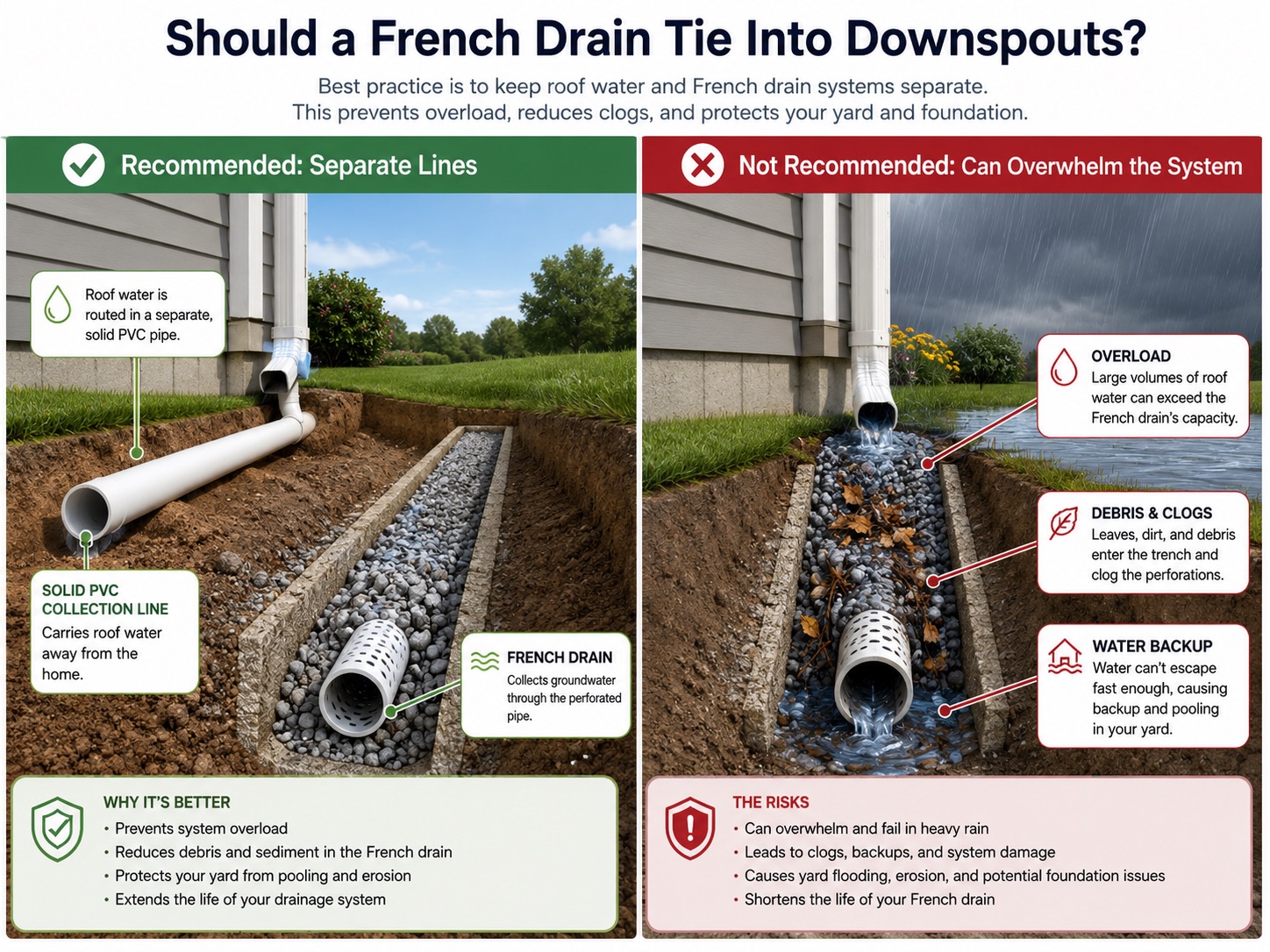
Roof water travels through its own solid-wall (non-perforated) PVC collection line, buried alongside but independent of the French drain, out to its own discharge point.
This keeps the French drain doing its actual job — managing subsurface groundwater and hydrostatic pressure — without also absorbing a sudden flood of roof runoff.
A downspout can release a large volume of water in a short burst during a thunderstorm, along with leaves, shingle grit, and debris — far more than a perforated pipe is designed to absorb along its length.
The result: the French drain gets overwhelmed in minutes, debris clogs the perforations from inside, and water backs up into the yard.
Warning Signs
Signs You Need a French Drain
- Water stays pooled within 5 feet of your foundation for more than 24 hours after a storm
- Spongy, saturated turf that never fully dries out between rain events
- Efflorescence (a chalky white salt residue) or visible moisture staining on foundation stem walls
- Water pooling along fence lines, or runoff flowing onto your property from a neighboring, higher-elevation lot
The Outcome
A Dry Yard and a Protected Foundation
Once installed, a properly engineered French drain intercepts groundwater and surface saturation before it ever reaches your foundation, dramatically reducing the swell/shrink cycle that drives foundation upheaval.
- A usable lawn, even after heavy spring storms, instead of standing water for days
- Real foundation protection by removing hydrostatic pressure and soil saturation
- Drier crawlspaces and lower stress on underground plumbing
- A system built for decades, not a patch redone after the next storm season
Don't wait for foundation movement.
Talk with a local, independent contractor today.
Do You Need One?
When a French Drain Helps — and When It Doesn't
Soggy yard or soil that stays wet for days, water pooling beside the slab, erosion along a slope, or water arriving from a higher neighboring lot.
A grading fix, longer downspout extensions, or a single catch basin can solve some problems at lower cost. A good contractor will tell you if that's all you need.
Related Options
Other Drainage Tools
A French drain is one of several tools. Many lots use more than one.
Local Notes
Permits, HOAs, and Where the Water Goes
Where the drain discharges matters. Water sent into the public right-of-way or storm system raises permit questions, and an HOA may have its own rules about changes to a lot. Check current requirements with the Town of Flower Mound and your HOA before work starts; this site can't confirm them for your property.
Foundation Connection
Drainage and Your Foundation
A French drain can reduce soil saturation near the slab, which helps limit further movement. It doesn't repair a foundation that has already settled. If you see cracks or sticking doors, read about foundation repair and consider an inspection. For pricing, see the French drain cost guide.
FAQ
Common Questions
Where should a French drain empty?
Where should a French drain empty?
To a legal, planned discharge point: a gravity outlet, a pop-up emitter in the yard, or a sump pump station. Sending it into the public right-of-way or onto a neighbor's lot raises permit and liability questions.
Can I install a French drain myself?
Can I install a French drain myself?
A simple one is possible, but consistent slope, the right materials, and a legal outlet decide whether it works. Mistakes are buried underground, so many homeowners hire it out.
Will a French drain work in clay soil?
Will a French drain work in clay soil?
Clay drains slowly, which is why water pools. A gravel-filled trench gives that water an easy path to a pipe, so a drain can still help in clay when it is designed and sloped correctly.
Free Inspection Request
Tell Us What's Going On
Leave your details and a local, independent contractor will follow up. No obligation.